Once you decide a driveway gate should slide instead of swing, the work is not finished. “Sliding” still means two different builds: a rolling gate that travels on a ground track, and a cantilever gate that hangs and moves without a track across the opening. On a Georgia property, that second choice is often the one that decides whether the entrance stays smooth in August heat, after a clay washout, or when pine straw piles up in the fall.
If you are still choosing between swing and slide, start with our guide to sliding gate vs swing gate. This article is the next step: which sliding system actually belongs on your driveway.
Sliding Is Not One Product
Homeowners, HOAs, and contractors often ask for a sliding gate after they realize a swing leaf will hit grade, a parked car, or the street. That is the right first filter. The follow-up question is how that leaf will travel.
A rolling (track) sliding gate rides on a rail set in or on the pavement. The hardware is familiar, and on a flat, well-drained pad it can run for years. A cantilever sliding gate does not cross the driveway on a rail. It is fabricated longer than the opening so a counterbalance section stays on the private side of the post line, and the leaf hangs from a roller assembly as it moves.
Both are sliding gates. They are not interchangeable on a sloped North Georgia drive, a gravel farm entrance, or a neighborhood cut that collects stormwater. Choosing the wrong one is how you end up with a gate that works at the demo and then starts “mystery failing” after the first wet season.
How a Rolling Track Gate Works
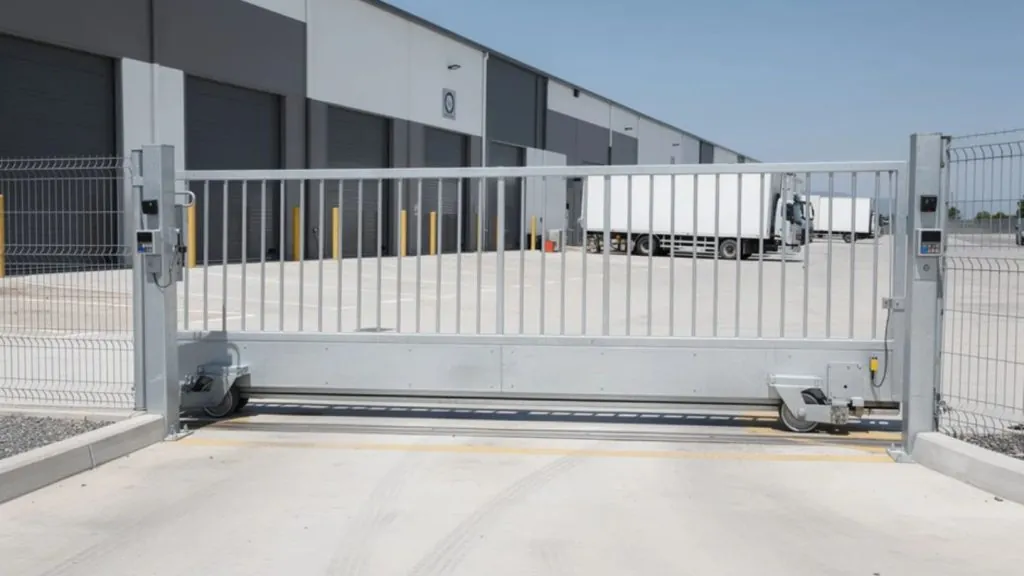
A track sliding gate uses a V-groove or similar wheel on a steel track. The track has to stay aligned, clean, and close to the same elevation across the full opening. If the track lifts, sinks, fills with debris, or gets hit by a plow, trailer tongue, or landscaping crew, the wheels climb, bind, or jump.
That is why rolling gates still make sense on some sites: a commercial pad that is already concrete, a level estate drive with good drainage, and an opening that stays clear of mulch and pine straw. The hardware is simpler. Lateral room along the fence is usually closer to the gate width plus a little extra for the operator and stops—not the longer tail a cantilever needs.
The weak point is the ground. In Metro Atlanta and North Georgia, that ground is often red clay that expands and contracts, plus a driveway that was never perfectly flat to begin with.
Why Ground Tracks Fail on Georgia Driveways
Georgia weather does not have to freeze a track solid to take a rolling gate out of service. Heat, humidity, and storms are enough, which is why we also write about how Cumming weather affects electric gate functionality. For a track gate, the failure is often mechanical before it is electrical.
- Clay and heave. A track set in a thin pad or on soil that moves will go out of plane. The gate starts to scrape, the operator works harder, and boards or photo-eyes get blamed first.
- Slope and washouts. Water running across a drive carries grit into the rail. After a storm, the wheels are rolling through mud instead of steel.
- Leaves, pine straw, and gravel. Fall is hard on rolling gates. A track is a trench. Whatever the wind drops in it becomes a speed bump for the wheels.
- Daily traffic. Delivery trucks, landscapers, and visitors do not always stay centered. One hard hit on a proud track section can start a bend that never quite sits true again.
If a property already fights standing water at the apron, or the opening sits at the bottom of a grade, a rolling gate is asking the site to stay perfect. Most Georgia sites will not.
How a Cantilever Gate Works
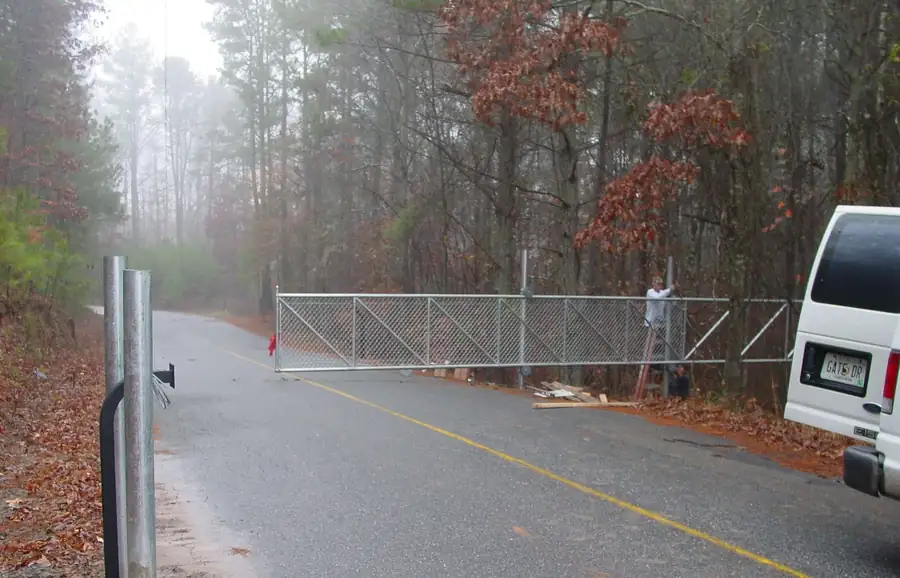
A cantilever gate is still a sliding gate. The difference is that the driveway itself is not part of the running surface. The leaf is supported on rollers mounted to a robust post-and-frame system on one side of the opening. A counterbalance section—the “tail”—stays behind the fence line so the gate stays level as it travels.
Because nothing has to be embedded across the opening, the gate can pass over uneven concrete, a slight crown, gravel, or a dip that would wreck a rolling wheel. That is the design we build in Cumming when a ground track is impractical, and it is why custom cantilever gates are specified for demanding openings, not only for snow country.
The tradeoff is space and fabrication. The finished leaf is longer than the clear opening—often on the order of 30 to 50 percent longer—so the counterbalance can do its job. You need a clear run along the fence or wall for that tail. You do not need extra depth in the driveway the way a swing gate does.
When a Cantilever Gate Is the Right Call
Choose cantilever when the site is trying to tell you a track will not last:
- The drive slopes, crowns, or falls away through the opening.
- The apron is gravel, dirt, or mixed pavement that will never stay as true as a shop floor.
- Stormwater, mulch, or pine straw collects where a rail would sit.
- Heavy vehicles cross the opening all day and would beat a track to death.
- You want the opening kept clean for trucks, boats, or emergency access with nothing to trip on or plow over.
It is also the cleaner spec when you already know the gate will be automated. An operator on a cantilever is moving a hanging leaf on a designed roller path. It is not fighting a rail that changes height every season. Pair that with the right access hardware from the start; our Cumming automatic gate planning guide covers power, safety devices, and HOA realities before you order an opener.
When a Rolling Track Gate Still Makes Sense
Cantilever is not automatic for every sliding job. A rolling gate can be the better, simpler build when:
- The opening is level, paved, and drains away from the track line.
- There is not enough fence-line length for a counterbalance tail.
- The entrance is lower-traffic and someone on site will keep the rail clear.
- The design is a shorter residential opening with a stable slab already in place.
Forcing a cantilever into a tight side yard is how you get a gate that never fully opens, or a tail that hits HVAC equipment, a meter, or a parked car. Site measurement comes first. If you are still matching opening size, travel direction, and fence style, use how to choose the right gate for your property as the planning checklist, then confirm slide type on the dirt—not on a catalog photo.
What to Spec Before You Buy an Operator
Automation does not fix the wrong gate. A sliding operator expects a leaf that travels true. On a rolling gate, that means the track is in plane. On a cantilever, that means the frame, rollers, and counterbalance were fabricated and set as a system.
Before anyone orders a motor, lock in:
- Clear opening width and which way the leaf will stack when open.
- How much room exists along the fence for a tail versus a track run.
- Grade through the opening and whether water crosses the apron.
- Leaf weight, material, and whether the gate must match an existing ornamental or steel fence line.
- Photo-eyes, edges, and other safety devices so the system is set up correctly for the travel path.
In-house fabrication matters here. A cantilever is not a stock panel with an opener bolted on. The counterbalance, roller spacing, and travel stops have to be built for that opening. That is the work we do in the Cumming shop before a crew shows up to set posts.
Match the Gate to the Fence Line
A cantilever gate should look like it belongs to the fence, not like a commercial afterthought. We fabricate steel cantilever gates to match fence profiles and finishes whenever the site allows. The same rule applies to a rolling leaf: pickets, spacing, and color should continue the line.
If the property already has ornamental steel or a signature line such as The Georgian or The Athens, bring that into the gate drawing. If you need the opening documented before anyone cuts steel, our CAD drawings step is how we keep the shop and the field on the same layout.
Final Thoughts
A rolling sliding gate and a cantilever sliding gate solve the same problem—moving a leaf out of the driveway without swinging it—in two different ways. The track version depends on the ground staying honest. The cantilever version depends on having room beside the opening and a frame built to hang true.
On many Georgia driveways, especially those with clay, slope, or a lot of debris, the track is the part that fails first. That is when a cantilever is not an upgrade. It is the gate the site needed from the start.
At Georgia Gate and Fence, we design, fabricate, and install both rolling and cantilever sliding gates from our shop in Cumming, then set them for homes, businesses, and communities across Metro Atlanta and North Georgia. Tell us about the opening, the grade, and how the entrance has to work day to day. Start your project or call (770) 664-1121 and we will spec the slide that actually belongs on your property.